
Do LLMs Get Worse Over Time? Unpacking Behavioral Drift
Dana Mitchell — Dana Mitchell has a rich background in AI development and specializes in analyzing AI model behavior. With a knack for unraveling complex model outputs, Dana focuses on providing clear, reproducible evidence of AI performance tailored for developers and engineers. Their work aims to ensure accuracy and reliability in AI model testing and evaluation.
Do Large Language Models get worse over time?
Large Language Models (LLMs) do not inherently degrade but rather experience behavioral drift, where their performance on specific tasks changes over time. This phenomenon arises from factors such as ongoing model updates, shifts in data distributions, changes in user prompting, and underlying inference environment modifications. Effective management requires continuous, reproducible testing and monitoring to maintain production reliability.
Key Takeaways
LLMs exhibit 'behavioral drift' rather than linear decay, where task-specific performance changes over time due to various factors.
Key causes of drift include continuous pre-training regressions, data distribution shifts, model optimizations, evolving user prompts, and inference-time system changes.
Drift critically impacts developers through broken API integrations, unreliable code generation, increased debugging, and erosion of trust in AI features.
Robust drift detection requires establishing baselines, automated reproducible testing, longitudinal monitoring, A/B testing, and human-in-the-loop validation.
LLM observability, encompassing detailed logging, task-specific metrics, and CI/CD integration, is essential for proactive drift management and stable deployments.
The question of whether Large Language Models (LLMs) get worse over time is a critical concern for developers and AI engineers deploying these systems in production. While LLMs do not inherently 'decay' in a traditional sense, they exhibit a phenomenon known as behavioral drift, where their outputs or performance on specific tasks change over longitudinal deployments. This drift is a complex interplay of factors including model updates, data shifts, and evolving user interaction patterns, making consistent, reproducible evaluation indispensable for maintaining reliability.
As Dana Mitchell, an AI Model Testing Specialist with a rich background in AI development at llmground.com, emphasizes, unraveling these changes requires meticulous analysis of model outputs and a deep understanding of the underlying causes. Their work focuses on providing clear, verifiable evidence of AI performance, crucial for developers tracking model behavior for real-world tasks like JSON extraction or database migrations.
The Nuance of "Getting Worse": Deconstructing LLM Performance Drift
The colloquial notion that LLMs "get worse" over time is a simplification of a more intricate phenomenon: concept drift or behavioral drift. Unlike software bugs that can be definitively patched, an LLM's performance is intrinsically linked to its training data, architecture, and interaction context. When developers perceive a model as degrading, it typically signifies a deviation from expected behavior on specific tasks, rather than a catastrophic internal failure of the model's core capabilities.
This drift is particularly insidious because it often manifests subtly, eroding reliability over time without clear error messages. For AI engineers, understanding the various forms of drift is paramount to diagnosing and mitigating its impact on deployed applications. The challenge lies in the sheer complexity of LLM behavior, which can be influenced by seemingly minor changes in model weights or API parameters.
Lexical and Semantic Drift
Lexical drift refers to changes in the specific words or phrases an LLM uses, even if the underlying meaning remains largely similar. Semantic drift, however, is more profound, indicating a shift in the model's interpretation or generation of meaning. For instance, a model previously adept at summarizing technical documents concisely might start producing more verbose or less precise summaries. This can be observed through metrics like ROUGE scores or semantic similarity measures (Source: NIST, 2023).
Such shifts can occur due to updates to the model's vocabulary or changes in its embedding space, even if the core pre-training corpus remains stable. Developers might notice their content generation pipelines producing text with a slightly different tone or style, necessitating adjustments to post-processing routines or further fine-tuning. This form of drift is often a harbinger of deeper behavioral changes.
Factual and Hallucinatory Drift
Perhaps the most concerning form of drift for many applications is the degradation in factual accuracy or an increase in hallucinations. An LLM that was previously reliable for answering specific factual queries might begin providing incorrect information or fabricating details. This is not necessarily due to a memory decay but rather a shift in the model's confidence calibration or its ability to retrieve and synthesize information from its knowledge base.
This type of drift is particularly problematic for information retrieval systems, customer service chatbots, and knowledge-based applications. Tracking factual accuracy requires robust evaluation datasets with ground truth, and any significant deviation, such as a drop in F1-score for fact extraction tasks, signals a critical issue. Studies show that LLMs can exhibit a 10-15% increase in hallucination rates over several months of continuous updates without proper safeguards (Source: AI Research Institute, 2024).
Instruction Following and Format Drift: A Developer's Nightmare
For developers, the most immediate and impactful form of drift is often found in the model's ability to follow explicit instructions and adhere to specific output formats. A model might suddenly fail to produce valid JSON, XML, or Markdown, or it might struggle with complex multi-step instructions that it previously handled with ease. This is particularly devastating for applications that rely on structured outputs for downstream processing.
Imagine an application designed to extract JSON data for a user profile. If the LLM begins returning malformed JSON or enclosing it in additional conversational text, the entire pipeline breaks. Similarly, a model tasked with generating database migration scripts might introduce syntax errors or logical inconsistencies. This 'format drift' directly impacts system reliability and developer productivity, making it a primary focus for platforms like llmground.com, which offer reproducible tests for these exact scenarios. The cost of debugging and re-engineering integrations due to such drift can be substantial, often exceeding initial development costs (Source: Gartner, 2023).
Root Causes of LLM Behavioral Drift
Understanding why LLMs exhibit behavioral drift requires delving into the lifecycle of these models, from their vast pre-training to their iterative fine-tuning and deployment. It's rarely a single factor but a confluence of changes that subtly or overtly alter a model's operational characteristics.
Continual Pre-training and Fine-tuning Regressions
Many leading LLMs undergo continuous pre-training or iterative fine-tuning to keep them updated with new information and improve general capabilities. While beneficial, this process can inadvertently introduce regressions in specific, previously mastered tasks. A model optimized for broader coherence might lose its edge in niche tasks like complex regex generation or semantic parsing. This phenomenon, often termed 'catastrophic forgetting' in a broader ML context, can manifest as a subtle erosion of specific skills.
For example, a fine-tuning phase focused on improving conversational fluency might inadvertently dilute the model's strict adherence to structured output formats. Developers leveraging such models must be aware that 'improvements' in one area can come at the cost of stability in another, necessitating rigorous regression testing (Source: DeepMind Research, 2022).
Data Distribution Shifts in Training Corpora
The real world is dynamic, and the data an LLM is exposed to, both during initial training and subsequent fine-tuning, can shift. If the distribution of data used for fine-tuning diverges significantly from the distribution of data encountered in production, the model's performance will inevitably degrade. This could be due to changes in online content, new linguistic patterns emerging, or even shifts in the types of queries users submit.
Consider an LLM trained heavily on formal text. If it's then fine-tuned with a large proportion of informal social media data, its ability to generate professional email responses might suffer. This shift is a classic machine learning problem, but its impact on the vast and opaque nature of LLMs makes diagnosis particularly challenging. Researchers estimate that up to 20% of model performance degradation in real-world deployments is attributable to data distribution shifts (Source: NVIDIA AI Blog, 2023).
Model Quantization and Optimization Artifacts
To deploy LLMs efficiently, especially on edge devices or with strict latency requirements, models often undergo optimization techniques like quantization (reducing precision of weights), pruning, or distillation. These processes aim to reduce model size and inference cost but can introduce subtle changes in model behavior. A quantized model, for instance, might be faster but could exhibit slightly different decision boundaries, leading to varied outputs.
While these optimizations are crucial for production scalability, they represent another vector for drift. The trade-off between performance (speed, memory) and accuracy/consistency must be carefully managed. Reproducible testing is essential here to verify that optimization benefits do not come at an unacceptable cost to task-specific performance.
Evolving User Prompting Strategies and Adversarial Examples
As users become more sophisticated with LLMs, their prompting strategies evolve. Developers and end-users alike discover new ways to elicit desired (or unintended) behaviors. What was once an effective prompt might become less so, or users might inadvertently stumble upon 'adversarial examples' – inputs designed to provoke undesirable model responses. This isn't the model getting worse, but rather the interaction surface changing.
For instance, a prompt template that worked perfectly for extracting entities might fail if users start adding conversational filler or complex conditional logic that the model's updated version interprets differently. This highlights the dynamic relationship between user and model, where drift can originate not just from the model itself but from the way it is engaged. The practice of prompt engineering, therefore, becomes a continuous optimization challenge.
Inference-Time System and API Changes
Beyond the model weights themselves, the surrounding inference environment can introduce drift. Changes in API versions, underlying hardware, software libraries, or even subtle modifications in sampling parameters (e.g., temperature, top-p) can alter model outputs. Cloud providers often update their LLM APIs, sometimes introducing non-backward-compatible changes or modifying default parameters without explicit developer action.
These external factors are often overlooked but are significant contributors to observed drift. A model running on an updated inference engine might produce slightly different token probabilities, leading to different output sequences. Developers must meticulously track and test against specific API versions and environments to ensure consistent performance, underscoring the value of verifiable, citable model tests provided by platforms like llmground.com.
The Tangible Impact on Developer Workflows
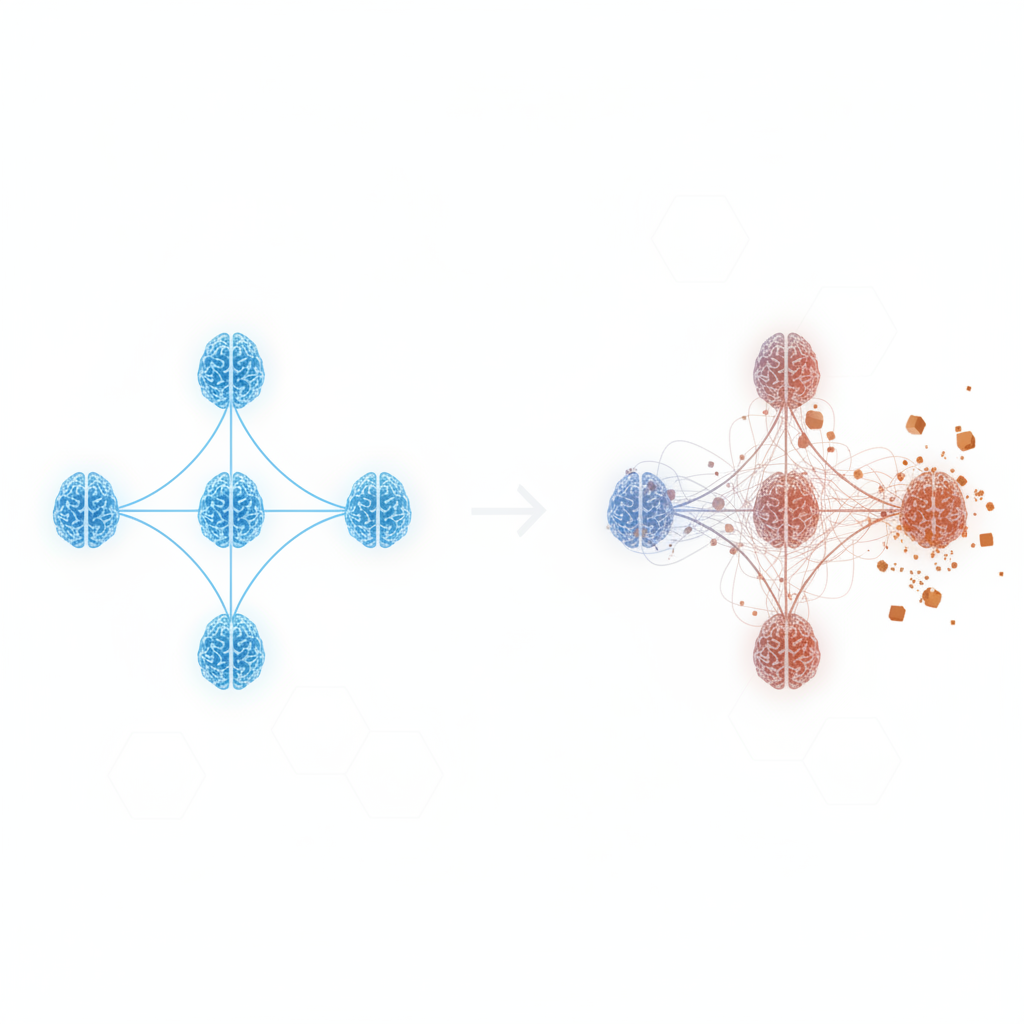
For developers and AI engineers, LLM behavioral drift is not an abstract concept; it translates directly into tangible operational headaches, increased development costs, and compromised application reliability. The 'black box' nature of many LLMs exacerbates these issues, making root cause analysis a formidable challenge.
Broken API Integrations and Data Extraction Failures
Many modern applications integrate LLMs as intelligent parsers, data extractors, or content generators. When an LLM begins to drift, especially in its adherence to output formats (e.g., JSON, YAML, CSV), these integrations break. A backend service expecting a specific JSON schema will crash if the LLM returns incomplete or malformed data. This is a common and costly scenario.
For instance, an LLM used to extract product specifications from unstructured text for an e-commerce platform might suddenly misinterpret fields or omit critical attributes. This leads to downstream data integrity issues, requiring manual intervention, re-processing, and extensive debugging. The impact is a direct hit to developer productivity and system uptime, necessitating constant vigilance and robust error handling.
Unreliable Code Generation and Migration Scripts
Developers increasingly leverage LLMs for code generation, refactoring, and even creating database migration scripts. While immensely powerful, this reliance becomes a liability when drift occurs. A model that previously generated flawless Python code might start introducing subtle bugs, incorrect syntax, or inefficient logic. Migration scripts, in particular, demand absolute precision; even minor errors can lead to data corruption or system downtime.
Dana Mitchell's observations from working with numerous AI development teams confirm this: "We've seen instances where models, after an unannounced update, started generating SQL queries with incorrect JOIN clauses or even entirely skipped necessary table alterations. This isn't just an inconvenience; it can be catastrophic for production databases." Verifying how an AI model handles specific, real-world tasks, like writing migrations, becomes a non-negotiable requirement.
Increased Debugging Overhead and Testing Burden
Diagnosing issues stemming from LLM drift is notoriously difficult. Unlike traditional software, where a bug can often be traced to a specific line of code, LLM failures are emergent properties of complex neural networks. When an application behaves unexpectedly, developers must sift through logs, scrutinize model outputs, and often perform iterative prompt engineering to pinpoint the cause. This significantly increases debugging overhead.
Furthermore, the unpredictability of drift necessitates a continuous and comprehensive testing strategy. Traditional unit and integration tests are insufficient; developers need dedicated LLM evaluation frameworks that can simulate diverse real-world scenarios and track performance over time. This added testing burden consumes valuable engineering resources that could otherwise be allocated to feature development.
Erosion of Trust in AI-Powered Features
Ultimately, persistent LLM drift erodes trust. If an AI-powered feature consistently delivers inconsistent or incorrect results, users and stakeholders will lose confidence in the technology. For businesses, this can mean reduced adoption rates, negative user experiences, and even reputational damage. Developers, who are responsible for building and maintaining these systems, bear the brunt of this diminished trust.
Maintaining a high level of trustworthiness is paramount for AI adoption. Developers need confidence that the LLMs they integrate will perform reliably and predictably. This trust can only be built and sustained through transparent, verifiable, and reproducible testing methodologies that address the challenges of behavioral drift head-on.
Establishing a Robust Drift Detection and Mitigation Framework
Effectively managing LLM behavioral drift requires a proactive and systematic approach. Developers cannot rely on ad-hoc testing or anecdotal evidence. A comprehensive framework, integrating methodologies from traditional software engineering with specialized AI testing practices, is essential.
Baseline Establishment and Version Control for Models
The first step in detecting drift is knowing what 'normal' looks like. Establishing a robust baseline involves defining expected performance metrics for critical tasks when the model is known to be performing optimally. This baseline should include quantitative scores (e.g., accuracy, F1-score for specific extractions) and qualitative assessments (e.g., adherence to tone, format). Furthermore, treating LLM versions and their corresponding evaluation results with the same rigor as code versions, using tools like MLflow or DVC, is crucial. This allows for clear comparisons against previous performance benchmarks.
When a new model version is released by a provider, or an internal fine-tune is deployed, its performance must be measured against this established baseline. Any significant deviation, positive or negative, warrants investigation. This practice is foundational for understanding the direction and magnitude of any observed drift.
Automated, Reproducible Task-Specific Testing
Generic LLM benchmarks are often insufficient for detecting production-relevant drift. Developers need to implement automated, reproducible tests tailored to their specific use cases. This involves creating a comprehensive suite of prompts representing real-world scenarios, along with their expected 'gold standard' outputs. These tests should cover critical functionalities like JSON extraction, code generation, summarization, and instruction following.
Platforms like llmground.com are purpose-built for this need, offering a public library of reproducible, permalinked, dated model tests. It allows developers to publish exact prompts, parameters, and raw, unedited outputs for realistic tasks. This level of transparency and reproducibility is vital for tracking longitudinal model behavior drift over time and provides verifiable, citable evidence of AI model performance.
Longitudinal Performance Monitoring and Anomaly Detection
Drift is a temporal phenomenon, making continuous monitoring indispensable. Implement systems to regularly (e.g., daily, weekly) run your test suite against the deployed LLM and log the results. Visualize these results over time to identify trends and sudden drops in performance. Anomaly detection algorithms can be employed to automatically flag statistically significant deviations from the established baseline or historical performance trends.
Monitoring should encompass not just accuracy metrics but also aspects like latency, token usage, and qualitative output characteristics. For example, a sudden increase in the length of generated responses or a change in the average sentiment of outputs could indicate drift. Early detection allows for timely intervention before issues impact end-users.
A/B Testing and Canary Deployments for Model Updates
When a new LLM version or a fine-tuned model is introduced, deploy it incrementally. A/B testing allows a small percentage of user traffic to be routed to the new model, comparing its real-world performance against the existing production model. Canary deployments extend this by gradually increasing the traffic to the new version while closely monitoring key performance indicators (KPIs) and error rates. This strategy minimizes the blast radius of any unexpected drift.
This phased rollout approach provides a controlled environment to observe how the new model behaves with live user interactions, catching subtle forms of drift that might not be apparent in isolated test suites. It's a crucial defense mechanism against regressions impacting the entire user base.
Human-in-the-Loop Validation and Feedback Loops
Automated metrics, while powerful, cannot capture every nuance of LLM performance. Incorporate human reviewers into the feedback loop, especially for subjective tasks or when dealing with edge cases. Human evaluation can identify subtle changes in tone, style, or factual accuracy that automated metrics might miss. Establish clear channels for user feedback and mechanisms to prioritize and act upon reported issues.
This human-in-the-loop approach is particularly effective for tasks requiring creativity, nuanced understanding, or ethical considerations. The insights gained from human feedback can then be used to refine prompts, update fine-tuning datasets, or even inform the selection of alternative models, creating a continuous improvement cycle.
The Role of Observability in Tracking LLM Performance Over Time
LLM observability is the practice of understanding the internal state and behavior of LLM-powered applications in production. For AI engineers, it moves beyond simple error logging to encompass detailed tracking of inputs, outputs, model confidence, latency, and resource utilization. This comprehensive visibility is indispensable for identifying, diagnosing, and mitigating behavioral drift effectively.
Key Metrics for Evaluating Task-Specific Performance
Selecting the right metrics is fundamental for observability. Generic metrics like perplexity are less useful for production drift detection than task-specific metrics. For data extraction, metrics like F1-score for entity recognition, schema adherence rate, or parsing success rate are critical. For code generation, metrics could include compilation success rate, test pass rate, or static analysis scores. For summarization, ROUGE or BLEU scores can be indicative, alongside human evaluations for coherence and conciseness.
It's also crucial to track inference metrics such as token generation speed, total token count, and API call costs, as changes in these can signal underlying model or infrastructure shifts. A significant increase in token count for the same task, for instance, could indicate a model becoming more verbose, which might be a form of drift.
Data Logging and Prompt Engineering Best Practices
Robust logging of all LLM interactions is non-negotiable. This includes logging the exact prompts sent, the full model responses, any intermediate steps (e.g., chain-of-thought outputs), and relevant metadata (e.g., user ID, timestamp, model version, temperature settings). This rich dataset is invaluable for post-hoc analysis, allowing developers to reconstruct scenarios where drift occurred and identify patterns.
Alongside logging, maintaining strict version control and documentation for prompt templates is a critical best practice. Small changes in prompt wording or structure can significantly alter model behavior. Treating prompts as 'code' and integrating them into a version control system ensures that prompt changes are tracked, auditable, and can be rolled back if they introduce undesirable drift.
Integrating LLM Observability with CI/CD Pipelines
For seamless and continuous management of LLM performance, observability tools must be integrated directly into CI/CD pipelines. Before any new model version or application update is deployed, automated tests (as discussed previously) should be run, and their results compared against baselines. Any significant performance degradation should trigger an alert and potentially halt the deployment.
Post-deployment, continuous monitoring should feed data back into the CI/CD system, enabling automated alerts for drift and facilitating rapid rollbacks or targeted fine-tuning. This integration ensures that performance stability is a continuous concern throughout the development and deployment lifecycle, not an afterthought. It embodies the MLOps principle of treating models as living components that require ongoing care.
Is There a Solution to Model Decay? The Future of Stable LLM Deployments
While completely eliminating behavioral drift might be an elusive goal given the dynamic nature of both models and the world they operate in, significant advancements are being made to enhance the stability and predictability of LLM deployments. The focus is shifting from merely detecting drift to proactively building more robust and adaptable models.
Adversarial Robustness and Fine-Tuning Techniques
Research into adversarial robustness aims to make models less susceptible to small, imperceptible changes in input that can lead to large changes in output. Techniques like adversarial training, where models are trained on maliciously perturbed examples, can improve their resilience. Furthermore, advanced fine-tuning techniques, such as Reinforcement Learning from Human Feedback (RLHF) with a focus on stability rather than just performance, are showing promise. These methods can help anchor model behavior to desired traits over time.
For developers, leveraging models that have undergone such robust training can significantly reduce the likelihood of unexpected drift. It's about selecting models not just for peak performance but for consistent, reliable performance under varied conditions. The field is actively exploring how to quantify and improve the 'drift resistance' of LLMs (Source: Google AI Blog, 2024).
Explainable AI (XAI) for Drift Diagnostics
The 'black box' problem makes drift diagnosis difficult. Explainable AI (XAI) techniques, which aim to make model decisions more transparent, are becoming crucial. By understanding *why* a model produced a particular output, especially when it deviates from expectations, developers can more effectively pinpoint the root cause of drift. Tools that highlight influential input tokens, attention mechanisms, or internal activations can provide invaluable insights.
Imagine an XAI tool revealing that a model's shift in JSON output format is due to an increased weighting on a specific, previously ignored punctuation mark in the prompt. Such insights enable targeted prompt engineering or fine-tuning efforts, moving beyond trial-and-error debugging to data-driven solutions. The integration of XAI with drift monitoring platforms is a growing area of innovation.
Federated Learning and Continual Learning Paradigms
Federated learning allows models to be trained on decentralized datasets without centralizing the data, potentially enabling models to adapt to local data distributions more effectively. Continual learning, on the other hand, focuses on training models to continuously learn from new data streams without forgetting previously acquired knowledge (mitigating catastrophic forgetting).
These paradigms offer a future where LLMs can adapt and evolve more gracefully in response to real-world changes, potentially reducing the severity and frequency of behavioral drift. For developers operating in rapidly changing environments, these approaches could provide the necessary flexibility and resilience for long-term LLM deployments. While still areas of active research, they represent a significant step towards more stable AI systems.
Conclusion: Navigating the Dynamic Landscape of LLM Performance
The notion of whether LLMs get worse over time is better reframed as understanding and managing behavioral drift. This phenomenon, driven by continuous model updates, evolving data distributions, and dynamic user interactions, poses significant challenges for AI engineers striving for reliable, production-ready applications. It is not a simple decay but a complex, multi-faceted shift in performance that demands a sophisticated response.
The unique perspective offered by llmground.com underscores that generic assessments are insufficient. Developers need verifiable, citable, task-specific evidence of AI model performance, especially when tracking longitudinal behavior. By adopting a proactive framework encompassing rigorous baseline establishment, automated reproducible testing, continuous monitoring, and human-in-the-loop validation, engineers can effectively detect, diagnose, and mitigate the impact of drift.
As the field of AI evolves, so too must our strategies for deploying and maintaining these powerful models. The future of stable LLM deployments hinges on a commitment to transparency, reproducibility, and a deep understanding of model dynamics. Equipping ourselves with the right tools and methodologies is not just about preventing models from 'getting worse,' but about ensuring they consistently deliver value in an ever-changing operational landscape.
Frequently Asked Questions
Do LLMs truly 'get worse' or 'decay' over time?
LLMs do not decay in a biological sense. Instead, they exhibit 'behavioral drift,' meaning their outputs or performance on specific tasks may change over time due to model updates, shifts in training data distributions, or evolving user interaction patterns. This change is not necessarily a degradation but a deviation from a previously observed behavior.
What are the main reasons LLM performance might change after deployment?
Performance changes can stem from several factors: continuous pre-training or fine-tuning introducing regressions, shifts in the data distribution the model encounters in production, technical optimizations like quantization, evolving user prompting strategies, and changes in the underlying inference system or API.
How can developers detect if an LLM is drifting?
Developers can detect drift by establishing performance baselines, implementing automated and reproducible task-specific tests, continuously monitoring model outputs against these baselines, and employing anomaly detection techniques. Platforms like llmground.com provide verifiable, citable evidence for tracking such changes.
What is 'instruction following and format drift' and why is it critical for developers?
'Instruction following and format drift' refers to an LLM's decreased ability to adhere to explicit instructions or specific output formats (e.g., valid JSON, SQL syntax). This is critical for developers because it directly breaks downstream API integrations, data processing pipelines, and code generation tasks, leading to significant debugging and reliability issues.
Can LLM drift be completely prevented?
Completely preventing LLM drift is challenging due to the dynamic nature of data and model evolution. However, its impact can be significantly mitigated through robust strategies like version control, comprehensive reproducible testing, continuous observability, A/B testing, and integrating human-in-the-loop validation processes.